<- back
 picoCTF2025: Virtual Machine 1
10 oct 2025
View solve on github
I thought it would be a good idea to try another picoCTF problem. I
noticed none of the problems on last week's picoCTF Mini were `hard`, so
I picked Virtual Machine 1. This problem has `429 solves` and a whopping
`30% satisfication rate`
The enemy has upgraded their mechanical analog computer. Start an
instance to begin.We grabbed this design doc from enemy servers:
Download. We know that the rotation of the red axle is the input and the
rotation of th axle is output. Reverse engineer the me blueechanism and
get past their checker program:thnc saturn.picoctf.net 60698.
## CAD Model
------------
First off,
.-----------------------------------------------------------------------
| zimengx@endeavour ~/S/p/P/virtualMachine1> unzip Virtual-Machine-1.zip
| Archive: Virtual-Machine-1.zip
| inflating: VirtualMachine1.dae
'-----------------------------------------------------------------------
we get a COLLADA `.dae` file??? A 3D File?? I don't have anything that
opens COLLADA files (blender removed support a few versions ago), so I
converted it into a STEP file using imagetostl.com
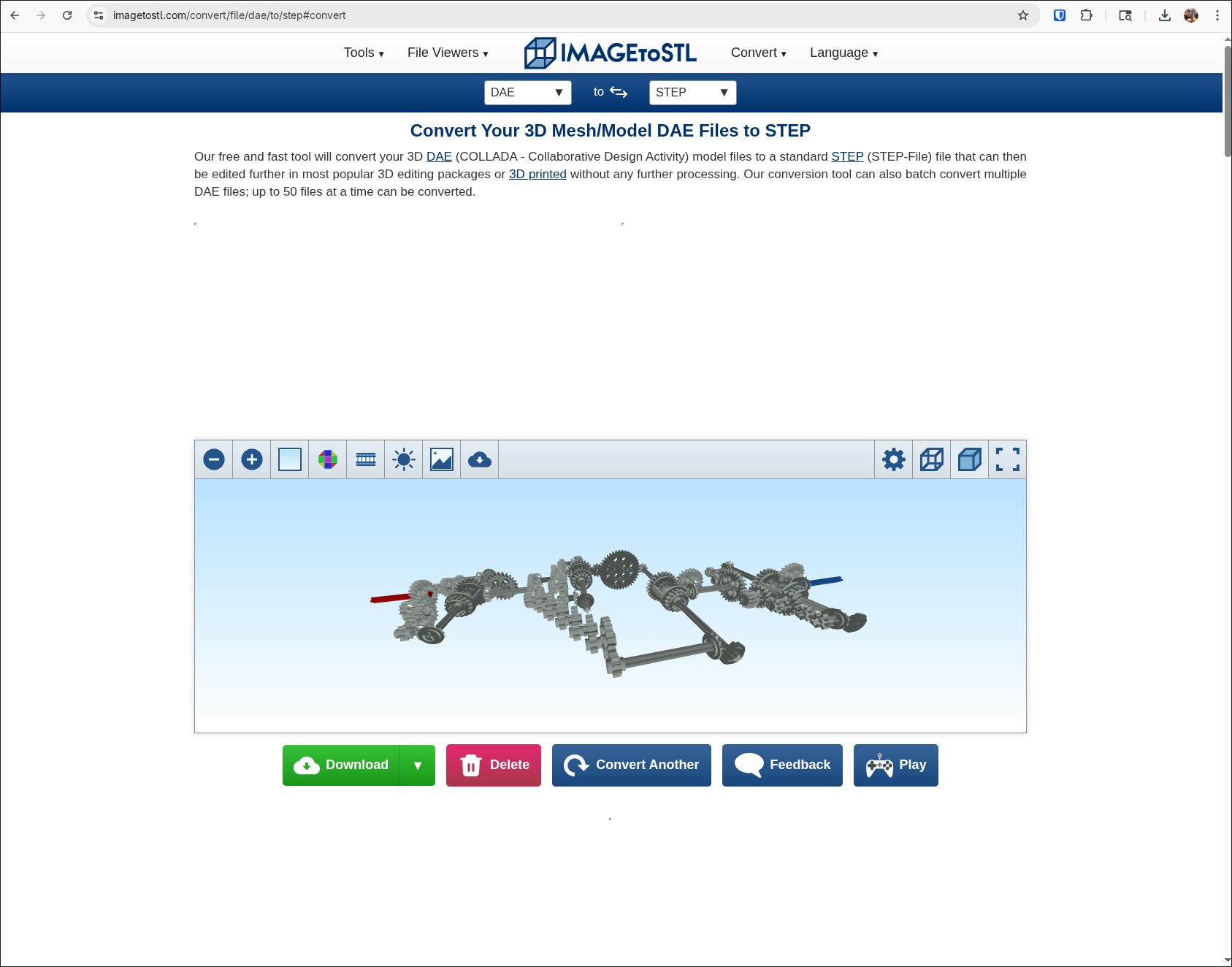 We get a sneak peak at the model, this will be fun...
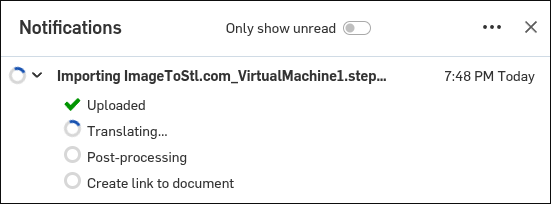 It looks like OnShape has failed to translate the file (over 30 minutes)
So I converted it into a .blend and opened it with blender
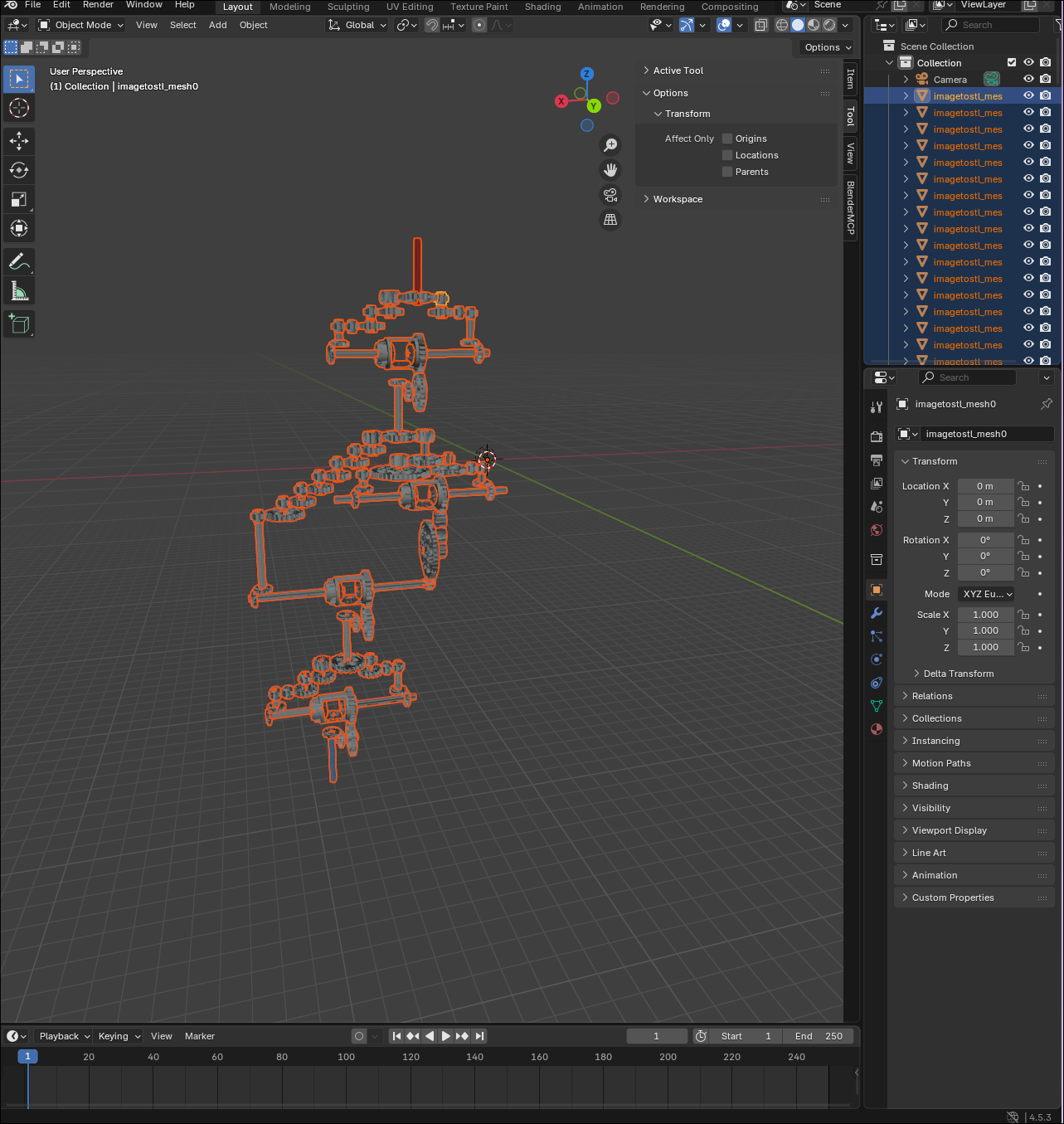 And then exported it as `.glTF` so I could import it into OnShape (I
think the gear relations and revolute parameters might come in handy)
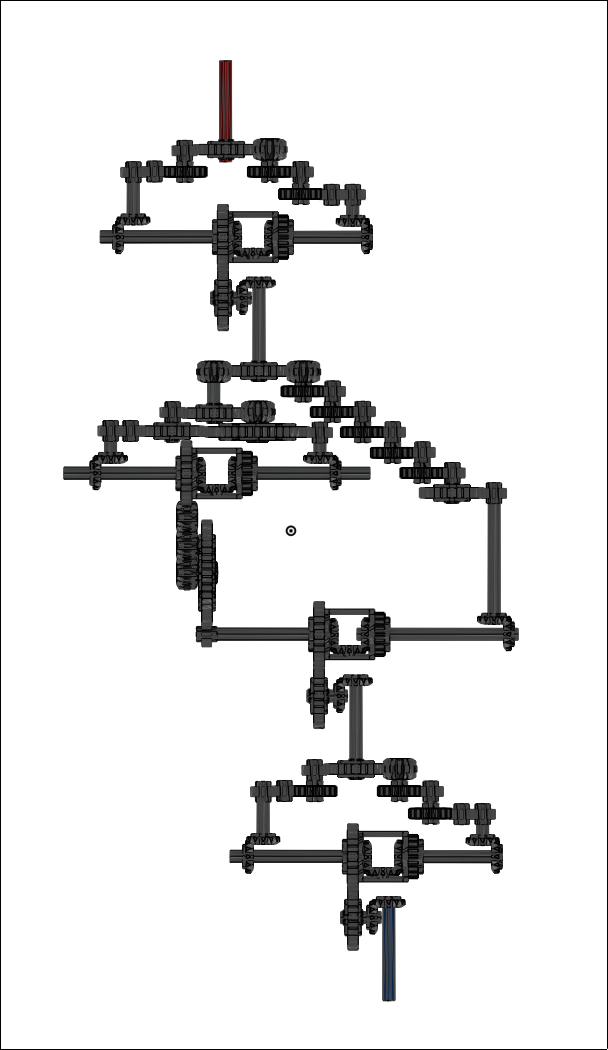
While it's converting (hopefully), lets inspect the model first, it
seems to be some Lego Technic gears, with some differentials(?)
Let's take a look at the instance first:
.-----------------------------------------------------------------------
| zimengx@endeavour ~/S/p/P/virtualMachine1 [SIGINT]> nc \
| saturn.picoctf.net 50299
| If the input to the machine is 20698, what is the output?
| Answer> ^C⏎
'-----------------------------------------------------------------------
It looks like the machine is a calculator, 50299 might in radians or
degrees or turns, or something like that. We have to solve for the
rotation of the output blue axle with relation to the red input axle.
The OnShape finished importing:
 ## Breaking down into Sections
------------------------------
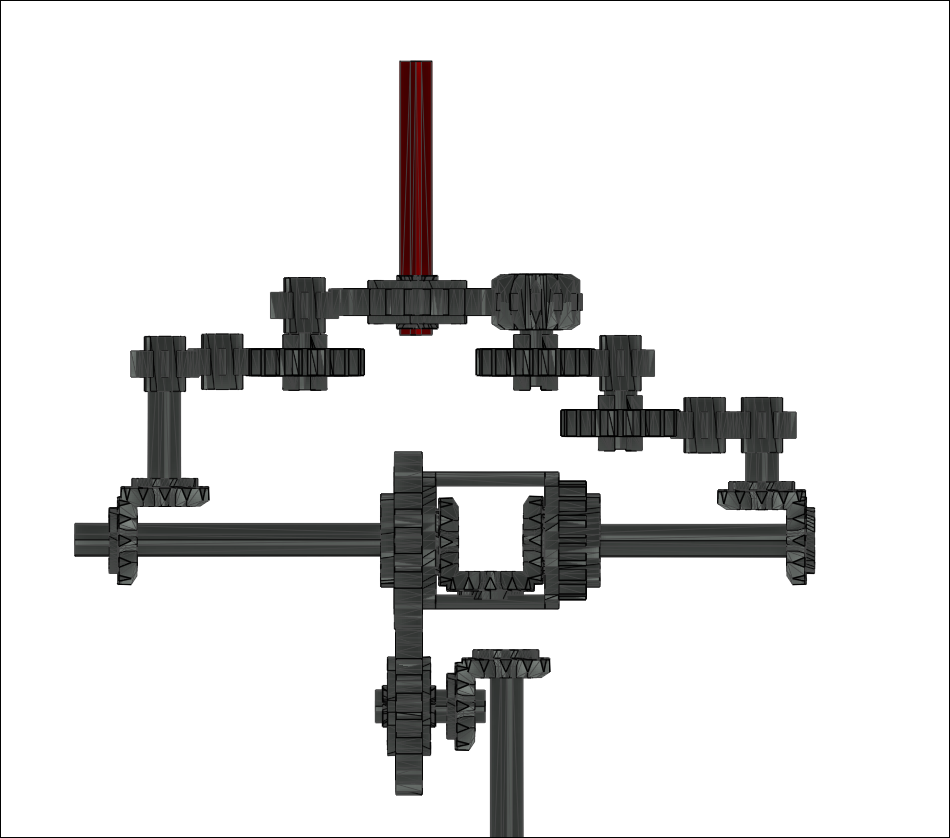
We can start working on it in sections:
 ### Lego Gears
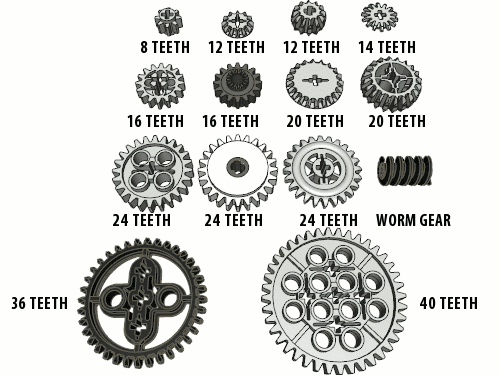
Here is a list of Lego gear sizes:
 And a differential
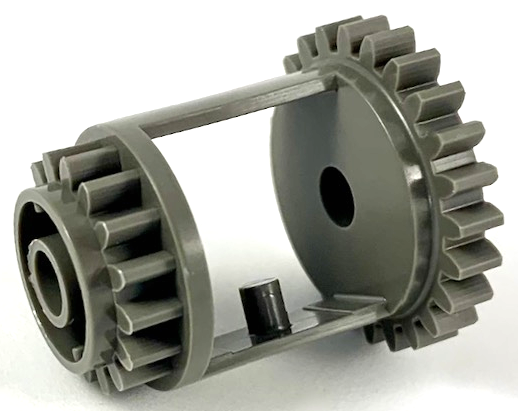 The differential is a `Technic, Gear Differential 24-16 Tooth`
Separating the gears, we see a total of 6 distinct gear ratios
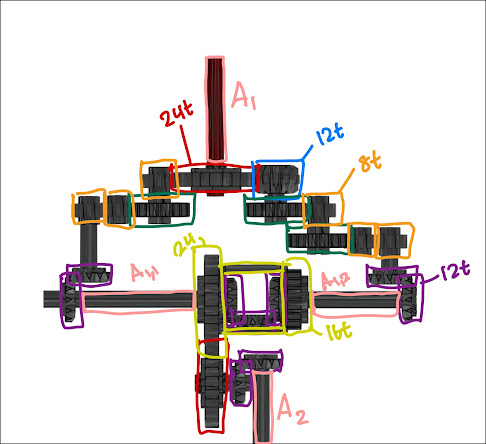 ### "Differential Equations", lol
The differential acts as an averaging mechanism for rotational
velocities:
ω_diff = (ω₁ + ω₂)/2
where ω₁ and ω₂ are the input rotational velocities. Thus, we need to
split this section into two parts, by first calculating A₁,₁ and A₁,₂
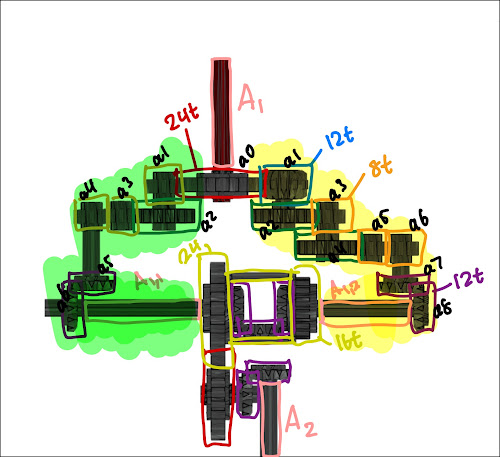 ## Section I
------------
We can derive both sections symbolically with python:
.-----------------------------------------------------------------------
| def A_1_1(A1):
| a0 = A1
| a1 = -a0*24/8
| a2 = a1
| a3 = a2*16/8
| a4 = -a3
| a5 = a4
'-----------------------------------------------------------------------
But wait...how do we handle rotation on different axis?? Let's define
positive rotation as clockwise when viewed from directly above. But the
question still remains, how do we define rotation in the horizontal
axis? Lets arbitrarily define it as clockwise when viewed from the right
when viewed from the back:
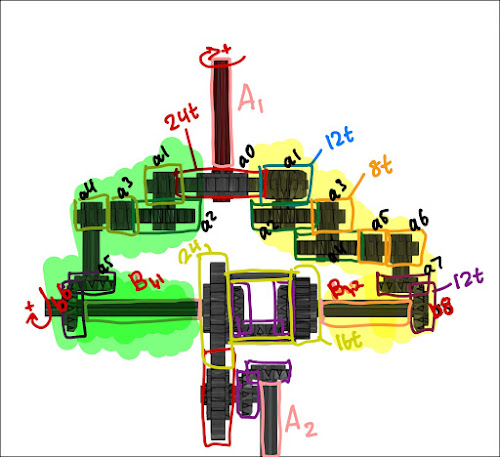
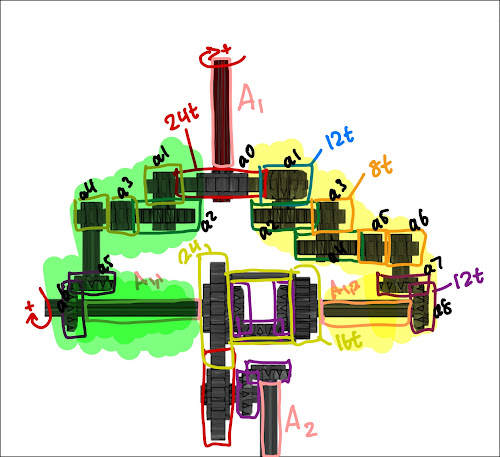 Let's also give the gears on different axis different names:
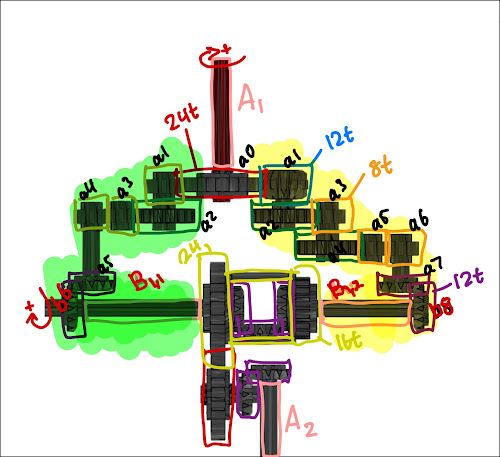 With this configuration, if a pitch axial gear (with ω b) is on the left
of a yaw axial gear (with ω a), then b=-a, and vice versa.
Thus,
.-----------------------------------------------------------------------
| def B_1_1(iA1):
| """
| Calculate first branch output for Section I
| Gear ratios: 24T:8T → 16T:8T → sign inversion
| """
| a0 = iA1
| a1 = -a0*24/8 # First gear reduction (24:8)
| a2 = a1
| a3 = -a2*16/8 # Second gear reduction (16:8)
| a4 = -a3 # Sign inversion
| a5 = a4
| b6 = -a5 # Final sign inversion
| return b6
|
| def B_1_2(iA1):
| """
| Calculate second branch output for Section I
| Gear ratios: 24T:12T → 16T:8T → 16T:8T
| """
| a0 = iA1
| a1 = -a0*24/12 # First gear reduction (24:12)
| a2 = a1
| a3 = -a2*16/8 # Second gear reduction (16:8)
| a4 = a3
| a5 = -a4*16/8 # Third gear reduction (16:8)
| a6 = -a5
| a7 = a6
| b8 = a7
| return b8
|
| def B1(b1_1, b1_2):
| """
| Differential averaging of both branches
| """
| return (b1_1 + b1_2)/2
'-----------------------------------------------------------------------
Now, we can calculate A₂, first labeling the gears
Section I Summary: A₂ = -A₁ × 24/8 × 16/8 × 1/2 = -A₁ × 3
 .-----------------------------------------------------------------------
| def A2(B1):
| b0 = -B1
| b1 = b0
| a0 = -b1
| return a0
'-----------------------------------------------------------------------
## Section II
-------------
Let's annotate in a similar fashion Section #2
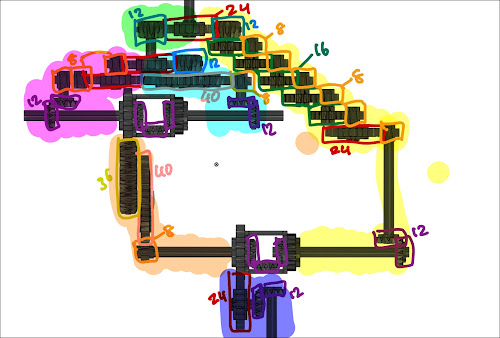 This looks daunting, but it's not that bad. We have 6 distinct sections.
Let's number them:
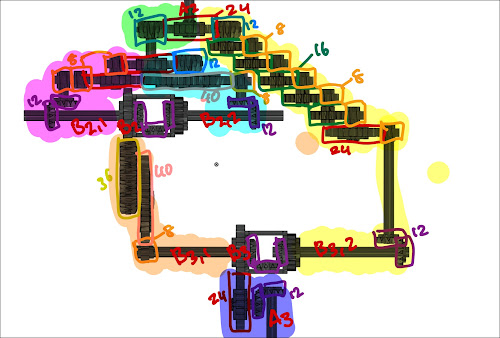 We can start coding now!
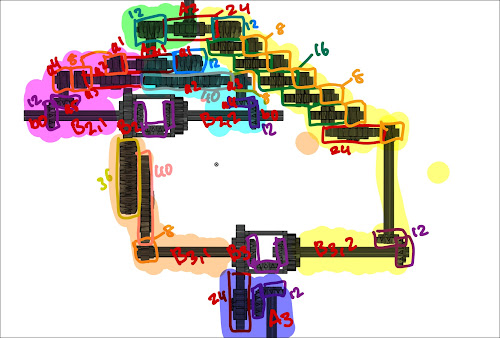 We now have B₂,₁ and B₂,₂:
.-----------------------------------------------------------------------
| def A_2_1(iA2):
| """
| First stage of Section II
| Gear ratio: 24T:12T
| """
| a0 = iA2
| a1 = -a0*24/12 # Gear reduction (24:12)
| return a1
|
| def B_2_1(a2_1):
| """
| First branch of Section II
| Gear ratios: 24T:8T → 24T:8T → sign inversions
| """
| a0 = a2_1
| a1 = -a0*24/8 # First gear reduction (24:8)
| a2 = a1
| a3 = -a2*24/8 # Second gear reduction (24:8)
| a4 = -a3 # Sign inversion
| a5 = a4
| b0 = -a5 # Final sign inversion
| return b0
|
| def B_2_2(a2_1):
| """
| Second branch of Section II
| Gear ratios: 24T:12T → 40T:8T
| """
| a0 = a2_1
| a1 = -a0*24/12 # First gear reduction (24:12)
| a2 = a1
| a3 = -a2*40/8 # Second gear reduction (40:8)
| a4 = a3
| b0 = a4
| return b0
'-----------------------------------------------------------------------
Then, we can derive B₃,₁:
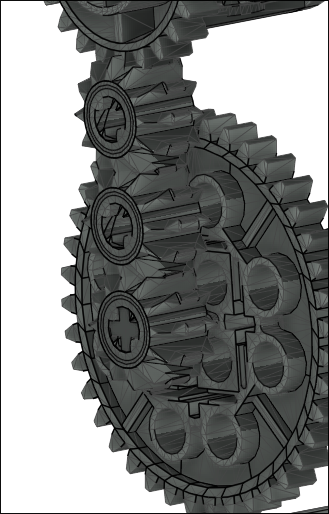
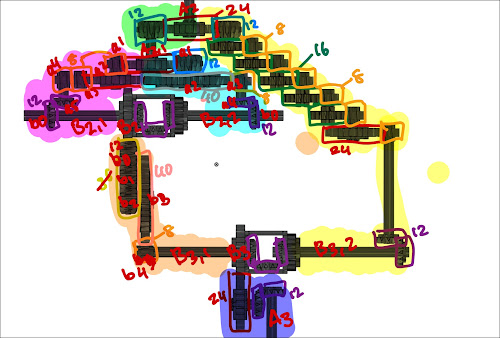 Ooops! It looks like this section (orange) is NOT a 36t, but 3x12. Now
we can calculate B₃,₁:
.-----------------------------------------------------------------------
| def B3_1(iB2):
| """
| First branch of Section III
| Gear ratios: 24T:12T → sign inversions → 40T:8T
| """
| b0 = -iB2*24/12 # First gear reduction (24:12)
| b1 = -b0 # Sign inversion
| b2 = -b1 # Sign inversion
| b3 = b2
| b4 = -b3*40/8 # Second gear reduction (40:8)
| return b4
'-----------------------------------------------------------------------
Moving on, we calculate B₃,₂ using A₂
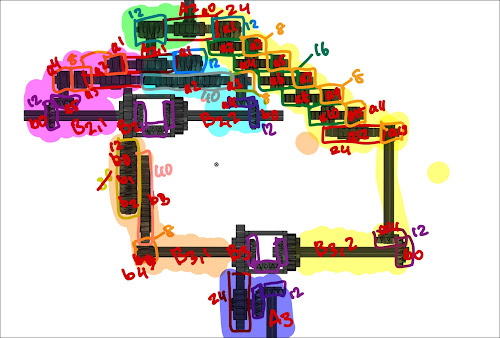 .-----------------------------------------------------------------------
| def B3_2(iA2):
| """
| Second branch of Section III
| Gear ratios: 24T:12T → 16T:8T → 16T:8T → 16T:8T → 16T:8T → 24T:8T
| """
| a0 = iA2
| a1 = -a0*24/12 # First gear reduction (24:12)
| a2 = a1
| a3 = -a2*16/8 # Second gear reduction (16:8)
| a4 = a3
| a5 = -a4*16/8 # Third gear reduction (16:8)
| a6 = a5
| a7 = -a6*16/8 # Fourth gear reduction (16:8)
| a8 = a7
| a9 = -a8*16/8 # Fifth gear reduction (16:8)
| a10 = a9
| a11 = -a10*16/8 # Sixth gear reduction (16:8)
| a12 = a11
| a13 = -a12*24/8 # Seventh gear reduction (24:8)
| a14 = a13
| b0 = a14
| return b0
'-----------------------------------------------------------------------
The approach is repetitive, but my brain is overwhelmed already, so I'll
do things the brute-force way.
With B₃,₁ and B₃,₂, we can calculate B₃ using the differential equation
(1):
.-----------------------------------------------------------------------
| def B3(B3_1, B3_2):
| return (B3_1 + B3_2)/2
'-----------------------------------------------------------------------
This allows us to calculate A₃ relatively easily:
Section II Summary: A₃ = -B₃ = -(B₃,₁ + B₃,₂)/2
.-----------------------------------------------------------------------
| def A3(B3):
| b0 = B3
| b1 = -b0
| b2 = b1
| a0 = -b2
| return a0
'-----------------------------------------------------------------------
## Section III
--------------
We notice a heuristic here,
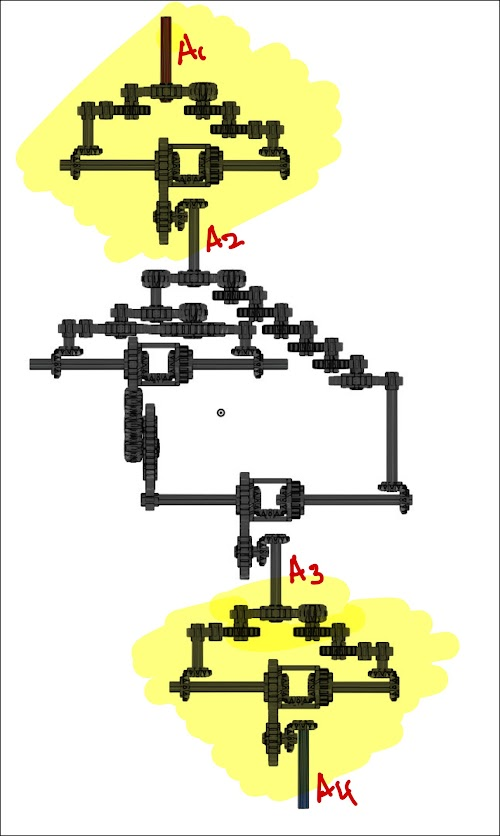 We notice A₁:A₂ = A₃:A₄, so we can use the same transformation function
for both sections.
Section III Summary: A₄ = A₂(A₃) = -A₃ × 3
Thus, we just plug A3 back into our A1->A2 function, and we solve the
entire system with:
.-----------------------------------------------------------------------
| ```python
| def A1_A2(a1):
| """
| Transform A1 → A2 through Section I
| """
| return A2(B1(B_1_1(a1), B_1_2(a1)))
|
| def A2_A3(a2):
| """
| Transform A2 → A3 through Section II
| """
| a2_1 = A_2_1(a2)
| b2 = B2(B_2_1(a2_1), B_2_2(a2_1))
| b3_1 = B3_1(b2)
| b3_2 = B3_2(a2)
| b3 = B3(b3_1, b3_2)
| return A3(b3)
|
| def A3_A4(a3):
| """
| Transform A3 → A4 through Section III (same as Section I)
| """
| return A1_A2(a3)
|
| def solveSystem(a1):
| """
| Complete system solution: A1 → A2 → A3 → A4
| """
| return A3_A4(A2_A3(A1_A2(a1)))
|
| print(solveSystem(-17198))
'-----------------------------------------------------------------------
## Complete System Solution
---------------------------
The complete system can be represented as a series of transformations:
A₂ = f₁(A₁) = -A₁ × 3 A₃ = f₂(A₂) = -(B₃,₁(A₂) + B₃,₂(A₂))/2 A₄ = f₃(A₃)
= -A₃ × 3
Final System Equation: A₄ = f₃(f₂(f₁(A₁)))
Where the overall transformation is: A₄ = A₁ × 9 × (B₃,₁(A₁ × 3) +
B₃,₂(A₁ × 3))/2
## Plugging it in
-----------------
Lets see if it works!
.-----------------------------------------------------------------------
| zimengx@endeavour ~/S/p/P/virtualMachine1> python3 solveSystem.py
| Traceback (most recent call last):
| File "~/SchoolDrive/picoCTF/Practice/virtualMachine1/solveSystem.p \
| y", line 113, in <module>
| print(solveSystem(1))
| ~~~~~~~~~~~^^^
| File "~/SchoolDrive/picoCTF/Practice/virtualMachine1/solveSystem.p \
| y", line 111, in solveSystem
| return A3_A4(A2_A3(A1_A2(A1)))
| ~~~~~^^^^^^^^^^^
| File "~/SchoolDrive/picoCTF/Practice/virtualMachine1/solveSystem.p \
| y", line 100, in A2_A3
| A_2_1 = A_2_1(A2)
| ^^^^^
| UnboundLocalError: cannot access local variable 'A_2_1' where it is \
| not associated with a value
'-----------------------------------------------------------------------
Nope, looks like my use of the same character as both the variable and
function name is causing issues.
.-----------------------------------------------------------------------
| zimengx@endeavour ~/S/p/P/virtualMachine1> python3 solveSystem.py
| -9359.0
'-----------------------------------------------------------------------
Looks like it works! Let's test it on our input.
.-----------------------------------------------------------------------
| zimengx@endeavour ~/S/p/P/virtualMachine1> nc saturn.picoctf.net 51644
|
| If the input to the machine is 13536, what is the output?
| Answer> -126683424
| That's not correct.
| You have to wait 360.0 seconds before trying again.
'-----------------------------------------------------------------------
Sighhh...this mean we only have one more attempt, let's invert the sign
of our input to see if we are using different coordinates.
Since I didn't want to wait 360 seconds, I launched a new instance and
inverted the number
.-----------------------------------------------------------------------
| print(solveSystem(-17198))
'-----------------------------------------------------------------------
.-----------------------------------------------------------------------
| zimengx@endeavour ~/S/p/P/virtualMachine1 [SIGINT]> nc \
| saturn.picoctf.net 53014
| If the input to the machine is 17198, what is the output?
| Answer> 160956082
| 160956082
| That's correct!
| picoCTF{xxxxxxxxxxxxxxxxxxxxxxxx}
'-----------------------------------------------------------------------
YAYYYYYYYYYY. Total time took: 2hr 10min including time it took to write
this, so I guess it would have taken roughly 2/3-1/2 the time without.
## Complete System Analysis
---------------------------
### Mathematical Summary
Key Equations:
1. Differential Averaging: ω_diff = (ω₁ + ω₂)/2
2. Section I Transformation (A₁ → A₂): A₂ = -A₁ × 24/8 × 16/8 × 1/2 =
-A₁ × 3
3. Section II Transformation (A₂ → A₃): A₃ = -(B₃,₁(A₂) + B₃,₂(A₂))/2
4. Section III Transformation (A₃ → A₄): A₄ = -A₃ × 3
Complete System Solution: A₄ = A₁ × 9 × (B₃,₁(A₁ × 3) + B₃,₂(A₁ × 3))/2
Full Code:
.-----------------------------------------------------------------------
| def B_1_1(iA1):
| a0 = iA1
| a1 = -a0*24/8
| a2 = a1
| a3 = -a2*16/8
| a4 = -a3
| a5 = a4
| b6 = -a5
| return b6
|
| def B_1_2(iA1):
| a0 = iA1
| a1 = -a0*24/12
| a2 = a1
| a3 = -a2*16/8
| a4 = a3
| a5 = -a4*16/8
| a6 = -a5
| a7 = a6
| b8 = a7
| return b8
|
| def B1(b1_1, b1_2):
| return (b1_1 + b1_2)/2
|
| def A2(iB1):
| b0 = -iB1
| b1 = b0
| a0 = -b1
| return a0
|
| def A_2_1(iA2):
| a0 = iA2
| a1 = -a0*24/12
| return a1
|
| def B_2_1(a2_1):
| a0 = a2_1
| a1 = -a0*24/8
| a2 = a1
| a3 = -a2*24/8
| a4 = -a3
| a5 = a4
| b0 = -a5
| return b0
|
| def B_2_2(a2_1):
| a0 = a2_1
| a1 = -a0*24/12
| a2 = a1
| a3 = -a2*40/8
| a4 = a3
| b0 = a4
| return b0
|
| def B2(b2_1, b2_2):
| return (b2_1 + b2_2)/2
|
| def B3_1(iB2):
| b0 = -iB2*24/12
| b1 = -b0
| b2 = -b1
| b3 = b2
| b4 = -b3*40/8
| return b4
|
| def B3_2(iA2):
| a0 = iA2
| a1 = -a0*24/12
| a2 = a1
| a3 = -a2*16/8
| a4 = a3
| a5 = -a4*16/8
| a6 = a5
| a7 = -a6*16/8
| a8 = a7
| a9 = -a8*16/8
| a10 = a9
| a11 = -a10*16/8
| a12 = a11
| a13 = -a12*24/8
| a14 = a13
| b0 = a14
| return b0
|
| def B3(b3_1, b3_2):
| return (b3_1 + b3_2)/2
|
| def A3(iB3):
| b0 = iB3
| b1 = -b0
| b2 = b1
| a0 = -b2
| return a0
|
| def A1_A2(a1):
| return A2(B1(B_1_1(a1), B_1_2(a1)))
|
| def A2_A3(a2):
| a2_1 = A_2_1(a2)
| b2 = B2(B_2_1(a2_1), B_2_2(a2_1))
| b3_1 = B3_1(b2)
| b3_2 = B3_2(a2)
| b3 = B3(b3_1, b3_2)
| return A3(b3)
|
| def A3_A4(a3):
| return A1_A2(a3)
|
| def solveSystem(a1):
| return A3_A4(A2_A3(A1_A2(a1)))
'-----------------------------------------------------------------------
## Other approaches
-------------------
Let's see how other people approached this problem. Searching for
"picoCTF 2025 Virtual Machine 1", I don't see any solution besides this
one, which did not provide a solution. Quite disappointing... I wanted
to see if there was a faster way.
Looking at it, I can't think of a faster way or a shortcut to solving
this, besides modeling it out in OnShape and doing gear relations for
each gear, this would help us solve A1->2 A2->3 relations faster? I
don't know how much faster it would be or how accurate it would be. It
would also be fun to build this out, but I would like to think that
would take more time.
 <- back
<- Markdown editors suck at handling files
Solving picoMini by CMU-Africa ->